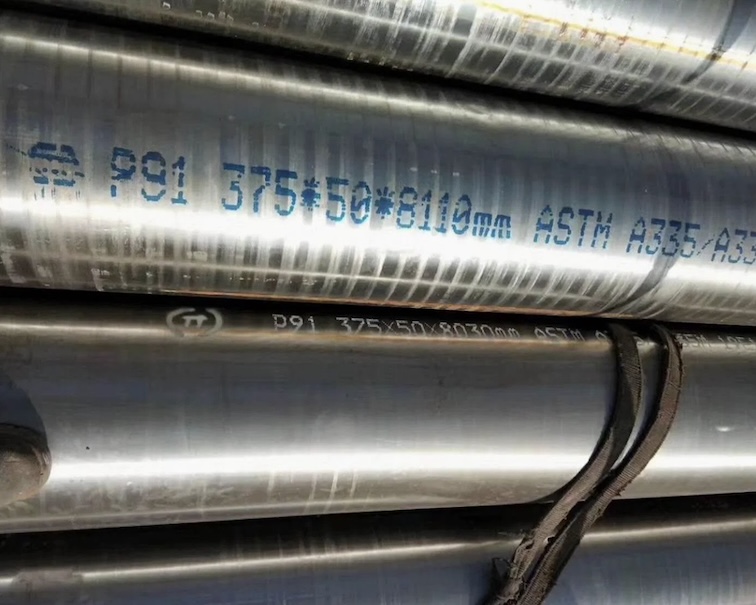
ASTM A335 P91 Alloy Steel Pipes – High-Temperature Seamless Pipes
We are a professional manufacturer and global supplier of ASTM A335 P91 seamless alloy steel pipes, specially designed for high-temperature, high-pressure, and long-term creep service.
ASTM A335 Grade P91 is a 9Cr-1Mo-V-Nb (modified 9Cr-1Mo) alloy steel, widely recognized for its excellent creep strength, oxidation resistance, and thermal fatigue performance.
ASTM A335 P91 alloy steel pipes are seamless ferritic alloy steel pipes designed for high-temperature service in power plants, petrochemical units, refineries, and thermal boilers. Developed for superior performance in elevated temperature and pressure conditions, P91 pipes offer exceptional creep strength, oxidation resistance, and weldability.
P91 pipes are made from a chromium-molybdenum-vanadium alloy (9Cr-1Mo-V), commonly referred to as Grade P91. The material is normalized and tempered to meet the requirements of ASME SA335 / ASTM A335
ASTM A335 Grade P91 Pipes are matching with ASTM A182 F91 forged fittings,A182 F91 Forged flanges,and A234 WP91 Pipe fittings.
Specification of A335 P91 Pipe
- Sizes: 1/2″ NB to 24″ NB (seamless)
- Schedules: SCH 40, 80, 160, XXS
- Length: 5–12 meters (or as required)
- Ends: Beveled / Plain
- Delivery Condition: Normalized and Tempered (N+T)
P91 Alloy Steel
P91 alloy steel is equivalent to the China standard 10Cr9Mo1VNb. T91/P91 (10Cr9Mo1VNb)
Characteristics of P91 Alloy Steel: It not only has high oxidation – resistance and high – temperature steam corrosion – resistance, but also has good impact toughness, high and stable lasting plasticity, and thermal – strength properties. When the service temperature is below 620°C, its allowable stress is higher than that of austenitic stainless steel. Above 550°C, the recommended design allowable stress is approximately twice that of T9 and 2.25Cr – 1Mo steel.
Application of A335 P91 Alloy Steel Pipe
It can be used as steel pipes for high – temperature superheaters and reheaters in sub – critical and super – critical boilers with wall temperatures ≤ 625°C, as well as for high – temperature headers and steam pipelines with wall temperatures ≤ 600°C. It can also be used as furnace tubes for nuclear power heat exchangers and petroleum cracking units.
P91 steel is a new type of martensitic heat – resistant steel jointly developed in the United States . It is based on 9Cr1MoV steel, with a reduced carbon content, strictly limited sulfur and phosphorus contents, and the addition of small amounts of vanadium and niobium for alloying. The chemical composition of P91 steel is shown in below table
There are 2 types of P91 grade according to the ASTM A335 standard. P91 type 1 and P91 type 2
| UNS Grade | UNS Designation | Carbon | Manganese | Phosphorus, max | Sulfur, max | Silicon | Chromium | Molybdenum | Others |
|---|---|---|---|---|---|---|---|---|---|
| P91 Type 1 | K90901 | 0.08 – 0.12 | 0.30 – 0.60 | 0.020 | 0.010 | 0.20 – 0.50 | 8.00 – 9.50 | 0.85 – 1.05 | V 0.18 – 0.25 N 0.030 – 0.070 Ni 0.40 max Al 0.02 max Nb 0.06 – 0.10 Ti 0.01 max Zr 0.01 max |
| P91 Type 2 Heat Product | K90901 | 0.08 – 0.12 0.07 – 0.13 | 0.30 – 0.50 | 0.020 | 0.005 | 0.20 – 0.40 | 8.00 – 9.50 | 0.85 – 1.05 0.80 – 1.05 | V Heat 0.18 – 0.25 Product 0.16 – 0.27 Ni 0.20 max Al 0.020 max N 0.035 – 0.070 N/Al ratio ≥4.0 Nb Heat 0.06 – 0.10 Product 0.05 – 0.11 Ti 0.01 max Zr 0.01 max Sn 0.010 max Sb 0.003 max As 0.010 max B 0.001 max W 0.05 max Cu 0.10 max |
Equivalent grade of P91 grade
The corresponding German steel grade for P91 steel is X10CrMoVNNb91, the Japanese steel grade is HCM95, and the French one is TUZ10CDVNb0901.
Alloy Elements in P91 Alloy Steel Pipe
These elements respectively play roles in solid – solution strengthening, dispersion strengthening, and improving the oxidation – resistance and corrosion – resistance of the steel. The specific analysis is as follows:
- Carbon: It is the element with the most obvious solid – solution strengthening effect in steel. As the carbon content increases, the short – term strength of the steel rises, while plasticity and toughness decrease. For martensitic steels like P91, an increase in carbon content will accelerate the spheroidization and aggregation rate of carbides, and speed up the redistribution of alloying elements, reducing the weldability, corrosion – resistance, and oxidation – resistance of the steel. Therefore, heat – resistant steels generally aim to reduce the carbon content. However, if the carbon content is too low, the strength of the steel will decrease. Compared with 12Cr1MoV steel, the carbon content of P91 steel is reduced by 20%, which is determined by comprehensively considering the above – mentioned factors.
- Nitrogen: P91 steel contains trace amounts of nitrogen, which plays roles in two aspects. On one hand, it has a solid – solution strengthening effect. At room temperature, the solubility of nitrogen in steel is very small. In the heat – affected zone of P91 steel during welding heating and post – weld heat treatment, the solid – solution and precipitation processes of VN will occur successively. During welding heating, the austenite structure formed in the heat – affected zone will have an increased nitrogen content due to the dissolution of VN, and then the degree of supersaturation in the room – temperature structure is increased. During the subsequent post – weld heat treatment, fine VN precipitates, which increases the structural stability and improves the lasting strength value of the heat – affected zone. On the other hand, P91 steel also contains a small amount of Al. Nitrogen can form AlN with it. AlN dissolves into the matrix in large quantities only above 1100°C and reprecipitates at lower temperatures, which can achieve a good dispersion – strengthening effect.
- Chromium: Adding chromium mainly improves the oxidation – resistance and corrosion – resistance of heat – resistant steel. When the chromium content is less than 5%, severe oxidation begins at 600°C, while when the chromium content reaches 5%, good oxidation – resistance is achieved. 12Cr1MoV steel has good oxidation – resistance below 580°C, with a corrosion depth of 0.05 mm/a, and its properties begin to deteriorate at 600°C, with a corrosion depth of 0.13 mm/a. The chromium content of P91 is increased to about 9%, and the service temperature can reach 650°C. The main measure is to dissolve more chromium in the matrix.
- Vanadium and Niobium: Both vanadium and niobium are strong carbide – forming elements. After being added, they can form fine and stable alloy carbides with carbon, having a strong dispersion – strengthening effect.
- Molybdenum: Adding molybdenum is mainly to improve the thermal – strength of the steel, playing a role in solid – solution strengthening.
Heat Treatment Process of A335 P91 Alloy Steel Pipe
The final heat treatment of P91 is normalizing + high – temperature tempering. The normalizing temperature is 1040°C, with a holding time of not less than 10 minutes. The tempering temperature is 730 – 780°C, with a holding time of not less than 1 hour. The structure after the final heat treatment is tempered martensite.
| Grade | Heat Treat Type | Normalizing Temperature, min or range °F [°C] | Cooling Media | Subcritical Annealing or Tempering Temperature, min or range °F [°C] |
|---|---|---|---|---|
| P91 Type 1 and Type 2 | normalize and temper or quench and temper | 1900 – 1975 [1040 – 1080] 1900 – 1975 [1040 – 1080] | 1350 – 1470 [730 – 800] 1350 – 1470 [730 – 800] |
Mechanical Properties of P91 Alloy Steel Pipe
The room – temperature tensile strength of P91 steel ≥ 585 MPa, the room – temperature yield strength ≥ 415 MPa, the hardness ≤ 250 HB, the elongation (for a standard round specimen with a gauge length of 50 mm) ≥ 20%, and the allowable stress value [σ] 650°C = 30 MPa.
TABLE 3 Tensile Requirements
| Grade | Value 1 | Value 2 |
|---|---|---|
| P91 Type 1 and Type 2 | 85 (585 MPa) | 60 (415 MPa) |
TABLE 4 Elongation Requirements
| Grade | Longitudinal | Transverse |
|---|---|---|
| P91 Type 1 and Type 2, Elongation in 2 in. or 50 mm, (or 4D), min, %: Basic minimum elongation for wall ⅝ in. [8 mm] and over in thickness, strip tests, and for all small sizes tested in full section | 20 | – |
| P91 Type 1 and Type 2, When standard round 2 – in. or 50 – mm gage length or proportionally smaller size specimen with the gage length equal to five times the diameter is used | 20 | 13 |
| P91 Type 1 and Type 2, For strip tests a deduction for each ¹⁄₃₂ – in. [0.8 mm] decrease in wall thickness below in. [8 mm] from the basic minimum elongation of the following percentage points shall be made | 1.00 | – |
ASTM A335 P91 Alloy Steel Pipe
- P91 steel relies on the alloying principle, especially with the addition of trace elements such as niobium and vanadium. Its high – temperature strength and oxidation – resistance have been significantly improved compared with 12Cr1MoV steel, but its weldability is relatively poor.
- Insertion – pin test results show that P91 steel has a relatively large cold – cracking tendency. Selecting a pre – heating temperature of 200 – 250°C and an inter – layer temperature of 200 – 300°C can effectively prevent the occurrence of cold cracks.
- Before post – weld heat treatment of P91, it must be cooled to 100 – 150°C and held for 1 hour; the tempering temperature is 730 – 780°C, with a holding time of not less than 1 hour.
- The above – mentioned welding process has been applied in the production practice of 200 MW and 300MW boiler manufacturing, achieving satisfactory results and obtaining significant economic benefits.
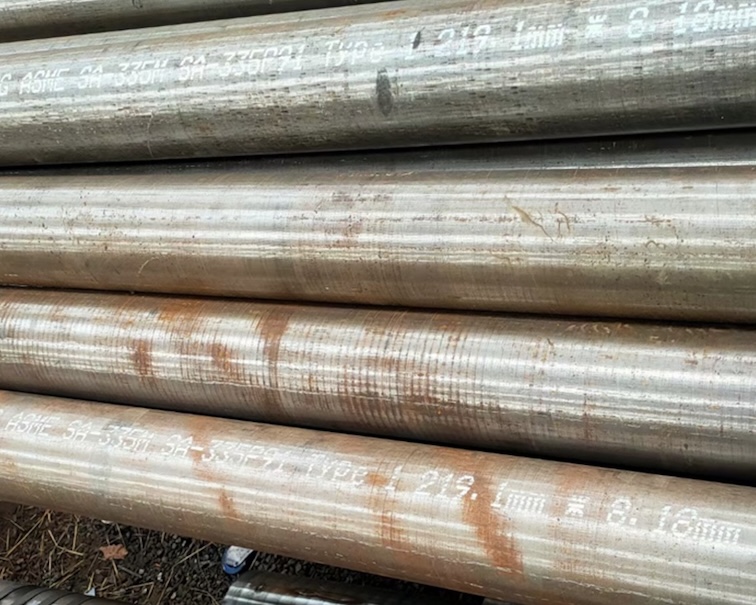
Difference between P91 Type 1 and type 2
The reduction of nitrogen and aluminum in Type 2 improves creep rupture life by minimizing the formation of brittle phases (e.g., Z-phase), which degrade the material under prolonged high-temperature stress. This makes Type 2 more suitable for >600°C service and extended operation (20–30 years) in high-efficiency power plants.
Manufacturing & Applicable Standards
- ASTM A335 / ASME SA335 – Alloy steel pipes for high-temperature service
- ASTM A999 / A999M – General requirements
- ASME B36.10M – Pipe dimensions
- ASME B31.1 / B31.3 – Power & process piping codes
Testing & Inspection
- Chemical composition analysis
- Tensile and hardness testing
- Charpy V-notch impact test (when required)
- Hydrostatic pressure test
- Nondestructive testing (UT / Eddy Current)
- PMI (Positive Material Identification)
- Dimensional & visual inspection
Certification: EN 10204 3.1 / 3.2
Third-party inspection available (SGS, TÜV, BV).
Product: ASTM A335 P91 Seamless Alloy Steel Pipe
Size: 8″ × SCH 80
Length: 6 m
Heat Treatment: Normalized & Tempered
Standard: ASTM A335
Certificate: EN 10204 3.1