Stud bolt length and tolerance are critical factors in ensuring proper flange joint integrity, gasket compression, and bolting performance.
Incorrect stud length or excessive tolerance can lead to insufficient thread engagement, uneven bolt stress, leakage, or installation difficulties.
Stud Bolt is widely used for the flange connection.while flanges have various size and working classes according ASME B16.5.Different size of the flanges would request different bolt size and length,so it is important for an engineer to know,how to calculate the stud bolt length.
As it is specified in ASME B16.5 Nonmandatory Appendices C,
Method For Calculating Stud Bolt Length:
The following equations were used in establishing dimension L as listed in various dimensional tables:
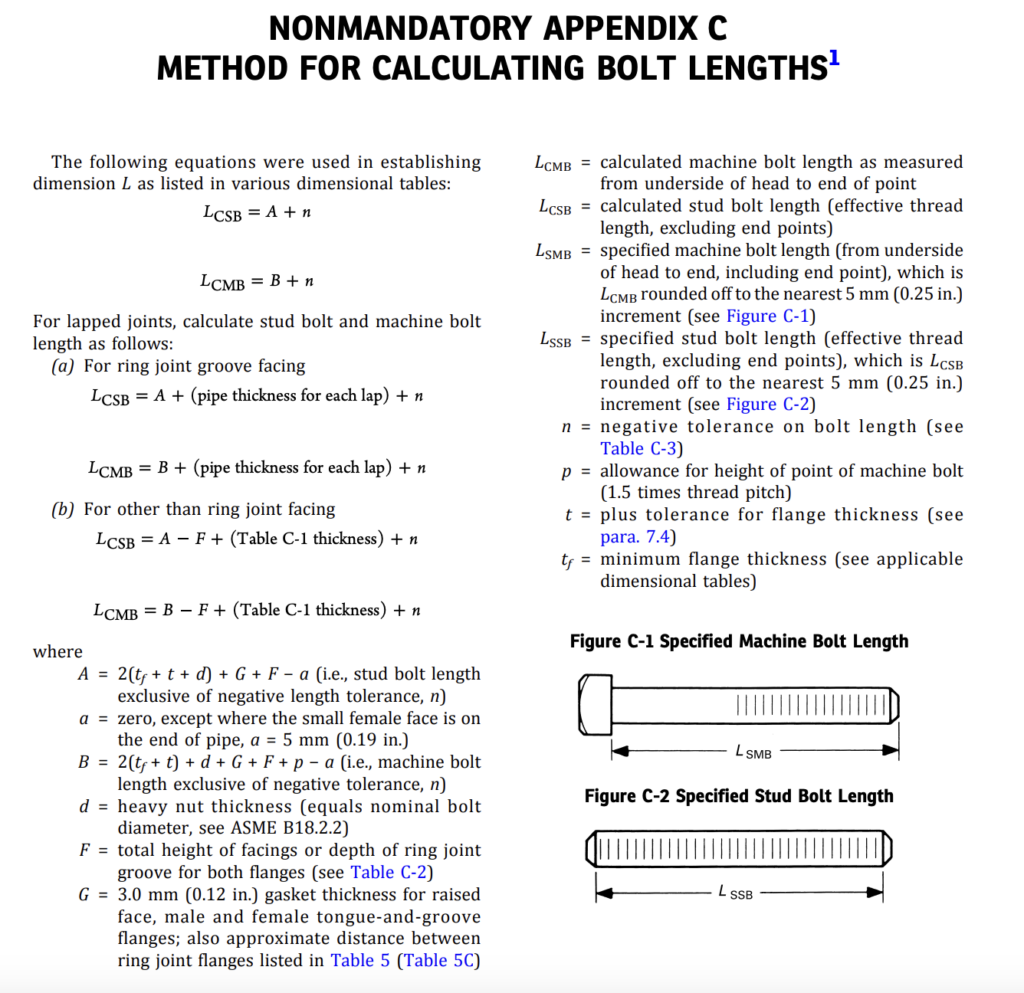
Stud Bolt Length Calculation (Flange Joint)
The required stud bolt length is typically calculated as:
Stud Length =
Flange thickness (both flanges)
- Gasket thickness
- Nut thickness (2 nuts)
- Washers (if used)
- Required thread protrusion
Length of a stud bolt
When we talk about the length of A stud bolt,it always refer to the “L”,effective thread length,the length thread to thread. (from the first full thread to the 1st full thread on the other length)
Please do not be confused the total length of the bolt with the thread length. you can find the detail explanation about the thread length as below.
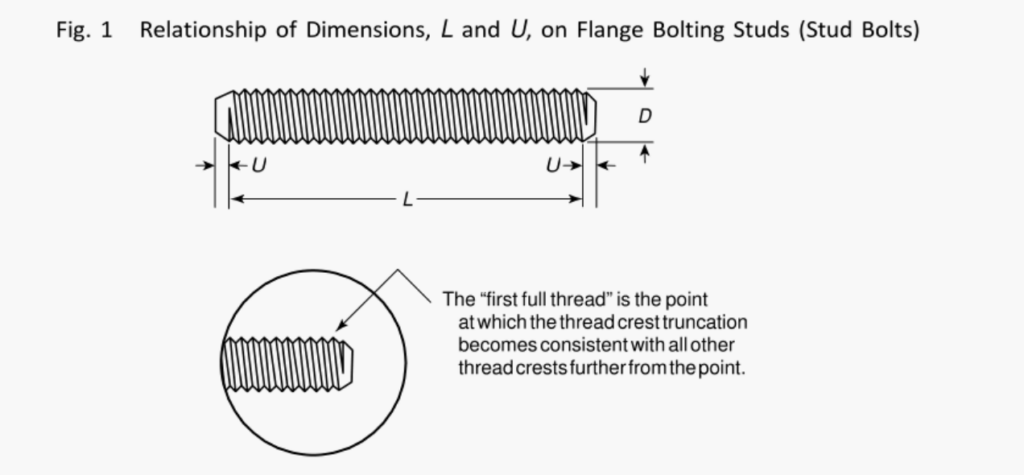
Dimension and UNC/UNF/8UN thread code for Imperial Bolt size
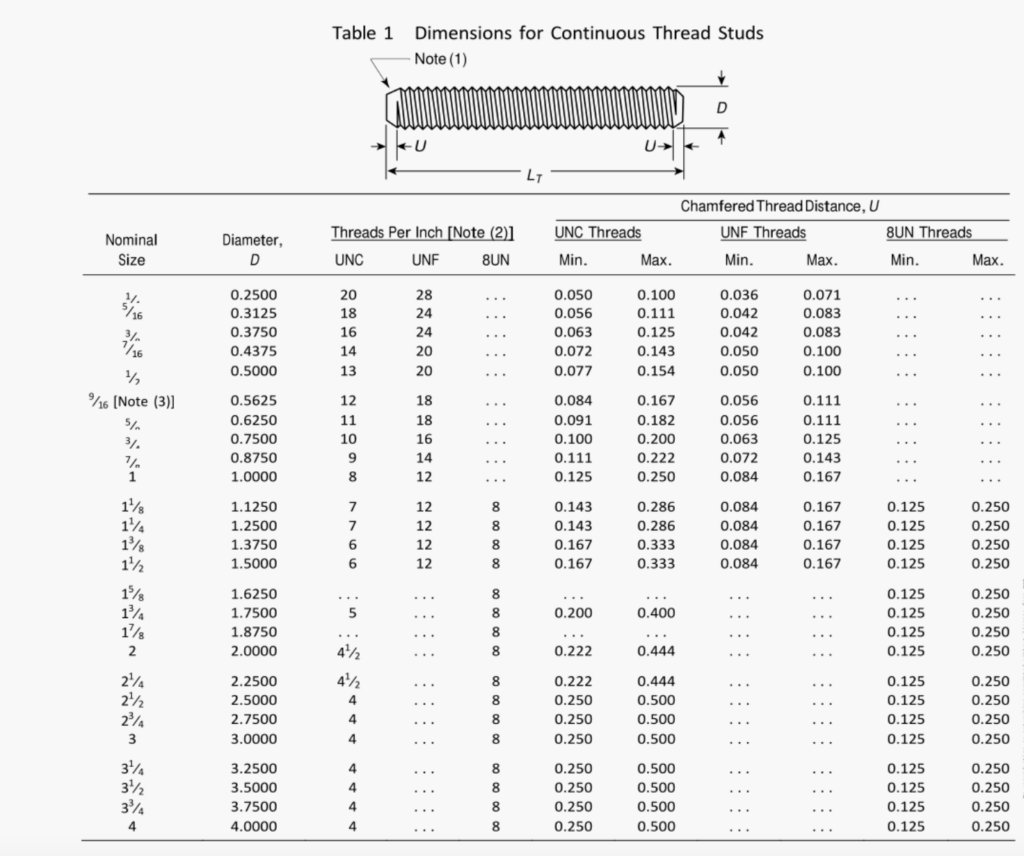
Length Tolernace for Studs
For studs conforming to ASME B18.31.2 (Continuous and Double-End Studs), the length tolerance is as follows,
These tolerances apply unless otherwise specified in the purchase order or design requirements
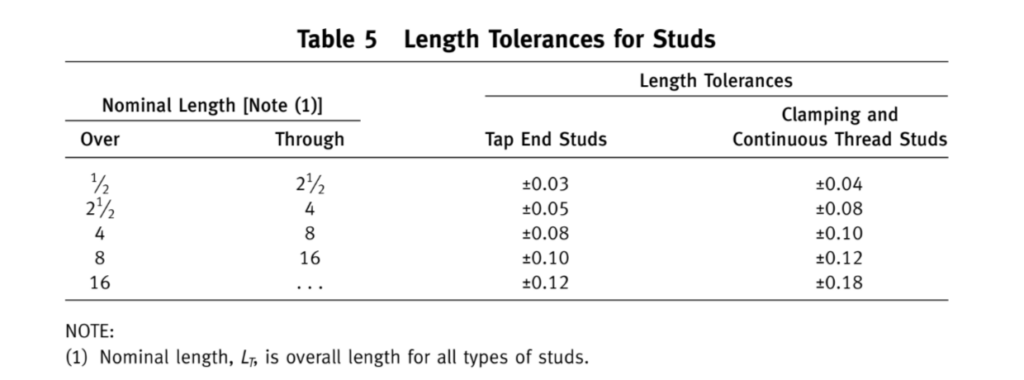
Difference Between continuous thread stud” and “flange bolting stud (stud bolt)
We can always see the requirement of the bolt like continuous thread Bolt,Full thread stud bolt. Are they the same?
The apperance is like the same.but actually they are not exactly the same.
The difference between “continuous thread stud” and “flange bolting stud (stud bolt)” is that the length of continuous thread stud is defined by the overall length from end to end while the flange bolting stud length is defined from the first full thread on one end to the first full thread on the other end. 7.1 Overall Length of Continuous and Double-End Studs The overall length, LT, of the continuous and doubleend type studs is the distance, parallel to the axis of the stud from one end to the other end, measured to the extreme condition on each end. The length tolerances in Table 5 are applied to this dimension. 7.2 Nominal Length for Flange Bolting Studs (Stud Bolts) The nominal length, L, on flange bolting studs (see Fig. 1) is the distance parallel to the axis of the stud from the first full thread on one end to the first full thread on the other end. Dimensions for U are the same as those in Table 1.
The length tolerances in Table 6 are applied to the L dimension. Flange bolting studs (stud bolts) can be made as continuous thread (Table 1) or double-end (Table 2) with the only difference being that nominal length, L, applies to flange bolting studs and overall length, LT, applies to all other stud types.
Thread Length & Engagement Requirements
For stud bolts used in flanged joints:
- Full thread engagement of the nut is mandatory
- At least one full thread protruding beyond the nut is generally recommended
- Excessive protrusion should be avoided to prevent interference or safety hazards
Inspection & Verification
Stud bolt length is verified by:
- Calibrated steel ruler or caliper
- Measurement between first full threads
- Visual inspection of chamfer and thread quality
For critical projects, length tolerance may be recorded in:
- Dimensional inspection reports
- EN 10204 3.1 MTC attachments
ASTM Standards & Tolerances
ASTM specifications such as:
- ASTM A193
- ASTM A320
- ASTM A453