Stainless Steel
Stainless Steel Material Grades
Last updated: 2025-12-26
Introduction
Stainless steel material grades are defined by chemical composition, mechanical properties, and performance in different service environments. Selecting the correct stainless steel grade is critical for ensuring corrosion resistance, strength, temperature stability, and long service life in industrial applications.
We supply a full range of stainless steel materials including austenitic, stabilized, duplex, and super duplex grades. This page provides DIN / EN equivalents, key alloy characteristics, and typical applications to assist engineers and procurement professionals in material selection for flanges, pipes, fittings, and plates.
Quick Navigation
Stainless Steel Material Grades Comparison Table (DIN / EN Equivalents)
| ASTM / AISI |
DIN / EN No. |
UNS |
Type |
Key Alloy Feature |
Typical Applications |
| 304 / 304L |
1.4301 / 1.4307 |
S30400 / S30403 |
Austenitic |
General corrosion resistance, excellent weldability |
General industry, food processing, piping systems |
| 316 / 316L |
1.4401 / 1.4404 |
S31600 / S31603 |
Austenitic |
Mo added for chloride corrosion resistance |
Chemical plants, marine/coastal, oil & gas |
| 317 / 317L |
1.4438 |
S31700 / S31703 |
Austenitic |
Higher Mo than 316 for stronger pitting resistance |
Chemical processing, pulp & paper, corrosive media |
| 316Ti |
1.4571 |
S31635 |
Stabilized Austenitic |
Ti stabilized + Mo; good at elevated temperature service |
Heat exchangers, chemical equipment, welded structures |
| 321 |
1.4541 |
S32100 |
Stabilized Austenitic |
Ti stabilized for high-temperature resistance |
High temperature piping, exhaust systems, petrochemical |
| 347 |
1.4550 |
S34700 |
Stabilized Austenitic |
Nb stabilized for long-term high-temperature service |
Power generation, boilers, refinery piping |
| 310S |
1.4845 |
S31008 |
Heat Resistant Austenitic |
High Cr & Ni for oxidation resistance at high temperature |
Furnaces, heat treatment, high-temp equipment |
| 904L |
1.4539 |
N08904 |
Super Austenitic |
High Ni & Mo; strong resistance to acids and chlorides |
Acid service, chemical plants, pollution control |
| Duplex 2205 |
1.4462 |
S32205 / S31803 |
Duplex |
High strength; excellent SCC & pitting resistance |
Offshore, seawater, oil & gas, desalination |
| Super Duplex 2507 |
1.4410 |
S32750 |
Super Duplex |
Superior corrosion resistance in aggressive environments |
Offshore oil & gas, seawater systems, chemical processing |
Note: DIN / EN equivalents are commonly used references. For critical projects, always confirm required specifications and certification documents.
Grade Families Overview
Austenitic & Stabilized Stainless Steels
Austenitic stainless steels such as 304, 316, 317, 316Ti, 321, 347, 904L and 310S are widely used due to their corrosion resistance, weldability, and formability. Stabilized grades (321, 347, 316Ti) are designed for elevated temperature service to reduce the risk of intergranular corrosion in welded structures.
Suggested reading:
Duplex & Super Duplex Stainless Steels
Duplex 2205 and super duplex 2507 combine high strength with excellent resistance to stress corrosion cracking and pitting corrosion, making them ideal for offshore, marine, and aggressive chloride environments.
Suggested reading:
Typical Application Selection Guide
| Service Condition |
Recommended Grades |
| General industrial use |
304 / 304L |
| Chloride environment (marine/coastal) |
316 / 316L, 317 / 317L, 316Ti |
| High temperature service |
321, 347, 310S |
| Strong acid service |
904L |
| Offshore / seawater / SCC risk |
Duplex 2205, Super Duplex 2507 |
Grade Details (Quick Cards)
304 / 304L (DIN / EN 1.4301 / 1.4307)
304 is a general-purpose austenitic stainless steel grade widely used for its good corrosion resistance, excellent weldability, and cost effectiveness. It is suitable for general industrial piping, food processing equipment, and standard stainless steel applications.
316 / 316L (DIN / EN 1.4401 / 1.4404)
316 contains molybdenum (Mo), providing improved pitting and crevice corrosion resistance in chloride environments. It is commonly used in marine/coastal projects, chemical processing, and oil & gas piping systems where enhanced corrosion resistance is required.
317 / 317L (DIN / EN 1.4438)
317 is an austenitic stainless steel grade with higher molybdenum content than 316, offering stronger resistance to pitting corrosion. It is often selected for more corrosive chemical processing environments.
316Ti (DIN / EN 1.4571)
316Ti is a titanium-stabilized version of 316, designed to improve resistance to intergranular corrosion after welding and to enhance performance in elevated temperature service. It is widely used for heat exchangers and chemical equipment.
321 (DIN / EN 1.4541)
321 is a titanium-stabilized stainless steel grade suited for high temperature applications. It provides improved resistance to intergranular corrosion in welded structures exposed to elevated temperatures.
347 (DIN / EN 1.4550)
347 is niobium-stabilized stainless steel designed for continuous high temperature service, offering enhanced structural stability and suitability for power generation and refinery applications.
310S (DIN / EN 1.4845)
310S is a heat-resistant austenitic stainless steel with high chromium and nickel content, providing excellent oxidation resistance at high temperatures. It is commonly used in furnaces and heat-treatment equipment.
904L (DIN / EN 1.4539)
904L is a super austenitic stainless steel grade with high nickel and molybdenum content, offering excellent resistance to strong acids and chloride corrosion. It is commonly used in chemical plants and corrosion-critical equipment.
Duplex 2205 (DIN / EN 1.4462)
Duplex 2205 provides higher strength than austenitic stainless steels and excellent resistance to stress corrosion cracking. It is widely used in offshore, seawater systems, and desalination projects.
Super Duplex 2507 (DIN / EN 1.4410)
Super duplex 2507 offers superior corrosion resistance and strength for highly aggressive environments such as offshore oil & gas and seawater systems, providing long service life and reliable performance.
Quality Control & Certification
All stainless steel materials supplied comply with applicable ASTM, DIN, and EN standards. Chemical composition and mechanical properties are inspected under strict quality control. EN 10204 3.1 mill test certificates are available upon request.
Product Forms & Standard
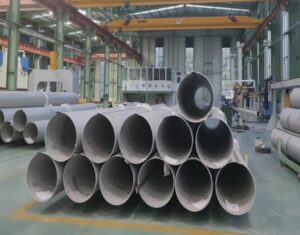
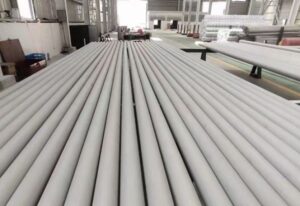
Pipes & Tubes
Used for fluid and gas transportation and heat exchangers.
Common standards:
Plates & Sheets
Used for pressure vessels, tanks, and fabrication.
Common standard:
Flanges
Used to connect pipes, valves, and equipment.
Common standards:
-
ASTM A182 (Material)
-
ASME B16.5 (Dimensions)
- ASME B16.47
Fittings
Used to change flow direction or pipe size.
Common standards: