What is PREN?
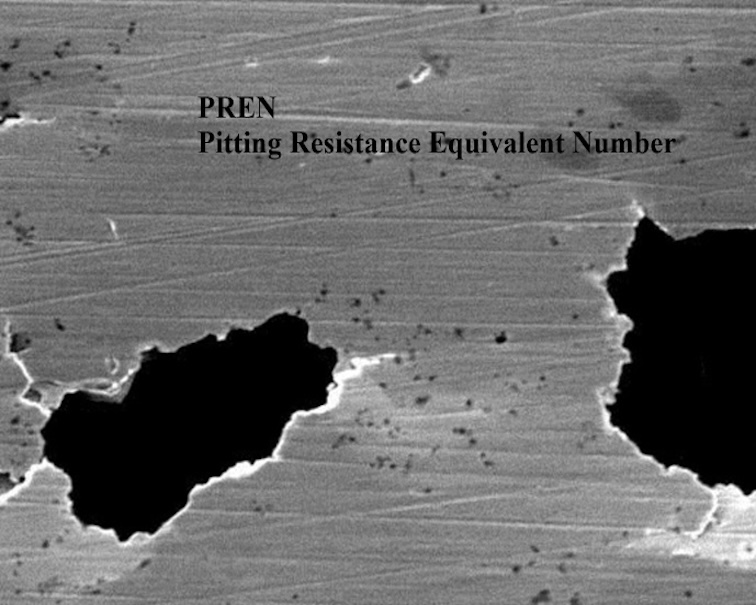
PREN refers to Pitting resistance equivalent number, a measurement of the corrosion resistance of stainless steel containing nickel
It combines the effects of key alloying elements—chromium (Cr), molybdenum (Mo), nitrogen (N), and sometimes tungsten (W)—into a single figure.
Pitting resistance equivalent numbers (PREN) are a theoretical way of comparing the pitting corrosion resistance of various types of stainless steels and are based on the chemical compositions and are useful for ranking and comparing the different stainless steel grades.
Actual or specified range compositions can be used and usually involve chromium, molybdenum and nitrogen in the calculations. Tungsten also appears in some versions of the calculation.
It should be noted that it is important to know the formula or formulae being used, in particular the weight being applied to each Alloying Element when more than one PREN is being compared.
Pitting resistance equivalent number (PREN) is a predictive measurement of a stainless steel’s resistance to localized pitting corrosion based on its chemical composition. In general: the higher PREN-value, the more resistant is the stainless steel to localized pitting corrosion by chloride.
PREN is frequently specified when stainless steels will be exposed to seawater or other high chloride solutions. In some instances stainless steels with PREN-values > 32 may provide useful resistance to pitting corrosion in seawater, but is dependent on optimal conditions. However, crevice corrosion is also a significant possibility and a PREN > 40 is typically specified for seawater service.
Calculation Method of Pitting Resistance Equivalent Number
Pitting Resistance Equivalent Number, abbreviated as “PREN” or “PRE value”. However, due to the different definitions of the PREN calculation method in different standards and literatures, the relevant calculation formulas in the literatures are listed as follows:
- The European standard EN 10088 – 1: 2005 stipulates as follows:
PRE = Cr% + 3.3Mo% + 16N% or Cr% + 3.3Mo% + 30N% (for the most commonly used formula for super austenitic/duplex ferritic stainless steel, and it is also applicable to austenitic steel with Mo greater than 3%); (Note: The standard includes NiCr22Mo9Nb, and the composition requirements are basically the same as N06625) - Standards such as ASTM A240, A789, and A790 stipulate as follows:
PRE = Cr% + 3.3Mo% + 16N%; (Note: Nickel – based alloys are not involved in the standard)
Typical PREN values for the Stainless steel grades
| Grade | Type | Cr | Mo | N | PREN |
| Ferritics | |||||
|---|---|---|---|---|---|
| 1.4003 | K03 | 10.5-12.5 | NS | 0.030 max | 10.5-12.5 |
| 1.4016 | 430 | 16.0-18.0 | NS | NS | 16.0-18.0 |
| 1.4113 | 434 | 16.0-18.0 | 0.9-1.4 | NS | 19.0-22.6 |
| 1.4509 | 441 | 17.5-18.5 | NS | NS | 17.5-18.5 |
| 1.4521 | 444 | 17.0-20.0 | 1.8-2.5 | 0.030 max | 23.0-28.7 |
| Austenitics | |||||
| 1.4301 | 304 | 17.5-19.5 | NS | 0.11 max | 17.5-20.8 |
| 1.4311 | 304LN | 17.5-19.5 | NS | 0.12-0.22 | 19.4-23.0 |
| 1.4401/4 | 316/316L | 16.5-18.5 | 2.0-2.5 | 0.11 max | 23.1-28.5 |
| 1.4435 | 316L (2.5% min Mo) | 17.0-19.0 | 2.5-3.0 | 0.11 max | 25.3-30.7 |
| 1.4406 | 316LN | 16.5-18.5 | 2.0-2.5 | 0.12-0.22 | 25.0-30.3 |
| 1.4539 | 904L | 19.0-21.0 | 4.0-5.0 | 0.15 max | 32.2-39.9 |
| 1.4563 | Sanicro 28 | 24.0-26.0 | 3.0-4.0 | 0.11 max | 35.9-43.0 |
| 1.4547 | 254SMO | 19.5-20.5 | 6.0-7.0 | 0.18-0.25 | 42.2-47.6 |
| 1.4529 | 1925hMo | 19.0-21.0 | 6.0-7.0 | 0.15-0.25 | 41.2-48.1 |
| 1.4565 | 4565S | 24.0-26.0 | 4.0-5.0 | 0.30-0.60 | 42.0-52.1 |
| Duplex | |||||
| 1.40621 | 2202 | 22.0 | 0.4 | 0.20 | 26.5 |
| 1.4162 | 2101LDX | 21.0-22.0 | 0.1-0.8 | 0.20-0.25 | 24.5-28.6 |
| 1.4362 | SAF 2304 | 22.0-24.0 | 0.1-0.6 | 0.05-0.20 | 23.1-29.2 |
| 1.4462 | SAF 2205 | 21.0-23.0 | 2.5-3.5 | 0.10-0.22 | 30.8-38.1 |
| 1.4410 | SAF 2507 | 24.0-26.0 | 3.0-4.0 | 0.24-0.35 | > 40 |
| 1.4501 | Zeron 100 | 24.0-26.0 | 3.0-4.0 | 0.20-0.30 | > 40 |
| 1.4507 | Ferrinox 255 | 24.0-26.0 | 3.0-4.0 | 0.20-0.30 | > 40 |
We can supply super duplex pipe and fittings ,and Super duplex UNS S32750 flanges with Pitting Resistance Equivalent Number>=40 (PREN>=40 ) to meet the requirements of shipping building and seawater equipments.
Super Stainless Steel
Super stainless steel refers to stainless steel with very high comprehensive corrosion resistance. Commonly used ones include super austenitic stainless steel, super duplex stainless steel, and super ferritic stainless steel. According to EN 10088 – 1: 2005 and the provisions of references [1 – 3], when evaluating the corrosion resistance of stainless steel grades based on the average value of standardized chemical compositions, for austenitic stainless steel and duplex stainless steel, when PREN ≥ 40, they are super austenitic stainless steel and super duplex stainless steel; for ferritic stainless steel, when PREN ≥ 35, it is super ferritic stainless steel. When the PRE of super duplex stainless steel is ≥ 45, it can also be called hyper stainless steel.