Stainless steel 304 and 316 are two of the most commonly used austenitic stainless steel grades in industrial applications. Both materials offer excellent corrosion resistance, good mechanical properties, and wide availability, making them popular choices for piping systems, flanges, fittings, and structural components.
However, despite their similarities, stainless steel 304 vs 316 shows important differences in chemical composition, corrosion resistance, and suitable service environments. Choosing the correct grade is critical for ensuring performance, durability, and cost efficiency in engineering projects.
Chemical Composition Difference
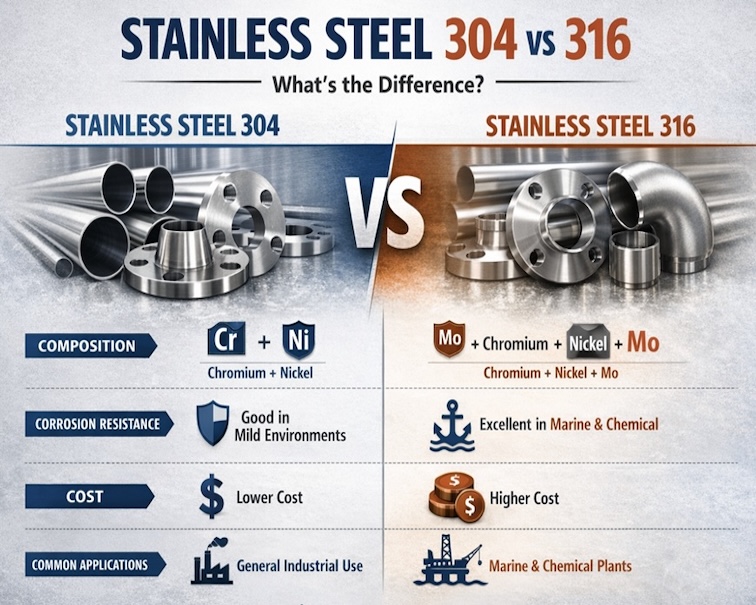
The primary difference between stainless steel 304 and 316 lies in their alloy composition.
- Stainless Steel 304
Contains chromium and nickel, providing good general corrosion resistance and excellent formability. - Stainless Steel 316
Contains chromium, nickel, and molybdenum (Mo). The addition of molybdenum significantly improves resistance to pitting and crevice corrosion, especially in chloride-rich environments. - Molybdenum is the main reason why stainless steel 316 performs better in harsh and corrosive conditions.
| Element | Stainless Steel 304 | Stainless Steel 316 |
|---|---|---|
| Carbon (C) | ≤ 0.08 | ≤ 0.08 |
| Silicon (Si) | ≤ 1.00 | ≤ 1.00 |
| Manganese (Mn) | ≤ 2.00 | ≤ 2.00 |
| Phosphorus (P) | ≤ 0.045 | ≤ 0.045 |
| Sulfur (S) | ≤ 0.030 | ≤ 0.030 |
| Chromium (Cr) | 18.0 – 20.0 | 16.0 – 18.0 |
| Nickel (Ni) | 8.0 – 10.5 | 10.0 – 14.0 |
| Molybdenum (Mo) | — | 2.0 – 3.0 |
| Iron (Fe) | Balance | Balance |
Corrosion Resistance peroformance
Stainless Steel 304
- Good corrosion resistance in most atmospheric and mildly corrosive environments
- Suitable for general industrial, food processing, and indoor applications
- Not recommended for high-chloride or marine environments
Stainless Steel 316
- Superior corrosion resistance due to molybdenum content
- Excellent performance in marine, coastal, and chemical processing environments
- Better resistance to acids, chlorides, and seawater
Conclusion:
For corrosive or marine environments, stainless steel 316 is the preferred choice.
Mechanical Properties
Stainless steel 304 and 316 have very similar mechanical properties, including tensile strength and yield strength. In most applications, mechanical performance is not the deciding factor between these two grades.
Both grades offer:
- Good toughness at low temperatures
- Excellent weldability
- Reliable performance under pressure
| Property | Stainless Steel 304 | Stainless Steel 316 |
|---|---|---|
| Tensile Strength | ≥ 515 MPa | ≥ 515 MPa |
| Yield Strength (0.2%) | ≥ 205 MPa | ≥ 205 MPa |
| Elongation | ≥ 40% | ≥ 40% |
| Hardness (HB) | ≤ 201 | ≤ 217 |
| Density | 7.93 g/cm³ | 7.98 g/cm³ |
| Melting Point | ~1400 °C | ~1375 °C |
Temperature Resistance
- Stainless Steel 304 performs well at moderate temperatures but may suffer from reduced corrosion resistance after prolonged exposure to high temperatures.
- Stainless Steel 316 offers slightly better high-temperature performance and maintains corrosion resistance more effectively under elevated temperatures.
For applications involving both heat and corrosive media, stainless steel 316 is generally preferred.
Cost Comparison: Stainless Steel 304 vs 316
Cost is an important consideration in material selection.
- Stainless steel 304 is more economical and widely available.
- Stainless steel 316 is more expensive due to the addition of molybdenum.
If corrosion resistance requirements are moderate, 304 offers a cost-effective solution. For harsh environments, the higher cost of 316 is justified by longer service life.
Applications Comparison
Common Applications of Stainless Steel 304
- General industrial piping
- Food and beverage equipment
- Water treatment systems
- Architectural and decorative applications
Stainless Steel 304 Products
Common Applications of Stainless Steel 316
- Marine and offshore equipment
- Chemical processing plants
- Oil & gas pipelines
- Pharmaceutical and medical equipment
Stainless Steel 304 vs 316: Which Should You Choose?
| Application Environment | Recommended Grade |
|---|---|
| General industrial use | Stainless Steel 304 |
| Cost-sensitive projects | Stainless Steel 304 |
| Marine or coastal areas | Stainless Steel 316 |
| Chemical processing | Stainless Steel 316 |
| Chloride-rich environments | Stainless Steel 316 |
Relationship with ASTM Standards
Stainless steel 304 and 316 are commonly supplied under various ASTM standards, including:
- ASTM A182 F304L Stainless steel flanges
- ASTM A182 F316L Stainless steel flanges
- ASTM A240 304 Stainless steel plates
- ASTM A240 316 Stainless steel plates
- ASTM A312 TP304 Stainless steel pipes
- ASTM A312 TP316 Stainless steel pipes
These standards define the chemical composition, mechanical properties, and application requirements for each grade.